I arrive in Tanzania in early October. The first thing to hit me after departing the airplane is the heat! Thirty degrees is the norm in Dar Es Salaam, a little overwhelming for a Canadian. I am provided with a nice apartment in a wealthier part of the city called Msasani. There are a lot of expats that live in this area, and the prices of food and transport reflect this. Here is a photo of the beach about a 15 minute walk from my house.
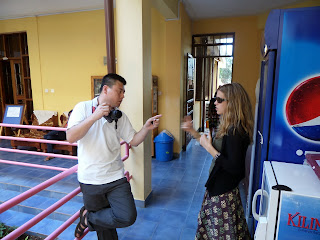
Following my warm welcome, I am whisked away for language training in the town of Morogoro for 2 weeks. We stayed at a hotel run by nuns. Here I am discussing swahili with another fellow learner (Chiang is a surgeon from China also trying to learn swahili).
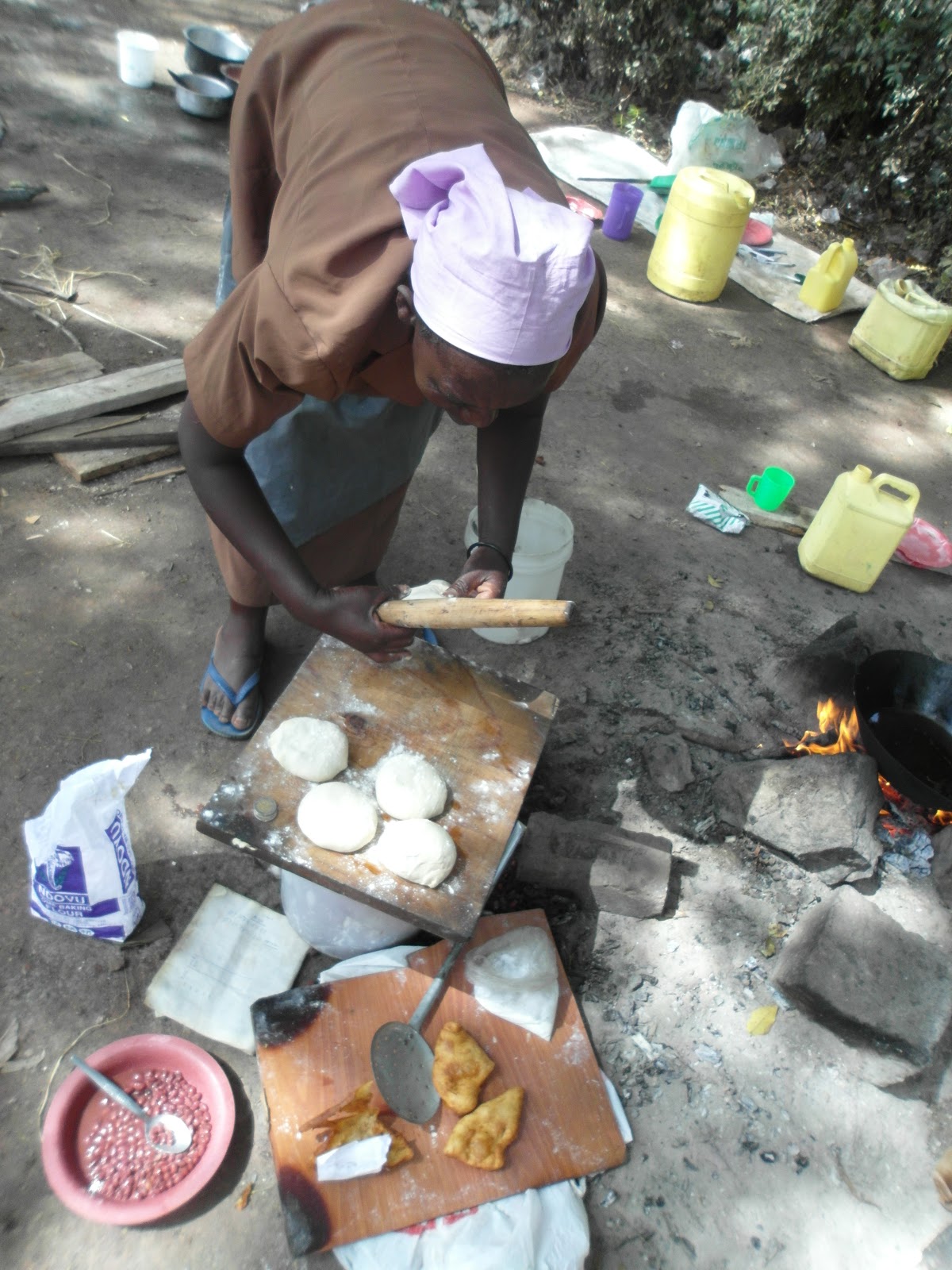
The first day I arrive in the office I am called upon to work on a logical framework for a rush proposal. While it was a little bit stressful trying to piece together information for a program I yet know nothing about, it was a good learning introduction. My job involves working with the M and E Coordinators throughout the country and creating a country wide M and E framework and process.
After one and a half weeks of office work I am asked to travel to the north of the country, Geita, to assist with a mid-term evaluation of their child labour project. Gold mining is big business in Geita. It employs men, women and even children. Below is a picture of one of the largest gold mining operations in Geita.
Children are not likely to work with large companies, rather are most often recruited from small scale mining companies providing children with toxic work but steady income. The toxicity comes from separating the gold from the dirt and sand using liquid mercury. My organization strives to get children out of the mines and back into school. There are several strategies being implemented to accomplish this large task. Some of which involve improving the income and livelihood of families at the household level through village savings groups. In addition, we are educating communities, government and village leaders about quality education. Further, we are also advocating to the government to build the capacity of schools to accommodate the stream of children in need of education. Currently, the schools are heavily under-resourced with limited teachers, supplies and infrastructure. I witnessed one school where there was a ratio of 100 children to 1 teacher.
Together with the evaluation team in Geita, we collected data from schools, teachers, students, and community groups. Below is a picture of a focus group discussion in one of the nearby villages.
It was great to have the opportunity to listen to the community members share their views. However, all of our interactions are conducted in Swahili. This provides me with a big reminder and incentive that I need to continue studying this language. Below is a picture of one of the staff members after interviewing the children at school.
During one of our visits to conduct interviews with the students, I witness a male teacher beating 10 of the girl students with a stick. They are beaten in front of the entire school and I witness them being hit over and over again (10 - 15 times). I feel completely powerless to do anything as I am representing my organization. Therefore, I stand in the doorway and glare at him hoping to communicate my disapproval. Unfortunately, my plan backfires and he merely moves the beatings inside where I cannot see. In Tanzania, it is legislated that teachers are allowed to hit children up to 3 times. (How compassionate right?) Unfortunately, this provision is not enforced, and teachers are given much leeway to discipline as they see fit.
Below is a picture of an extracurricular program involving drums at a nearby school. (This picture was not taken at the school where the beatings were conducted).
Following field work and data collection for the child labour project, I am provided with the opportunity to attend a Village Health Day. Men, women and children are invited to attend a dispensary for education, information, free vaccinations and check-ups for their children. Below is a picture of a dispensary and line up of women and children awaiting medical attention.
I witness an abundance of young mothers lining up for hours at a time to get their child examined. Young mothers are toting as many as 4 children. One on their back, one on their front, and two little ones walking beside. You can see their struggle trying to transport these children several kilometers without any help. Some children are tired and are crying and the young mothers are doing their best to accommodate everyone. I am always amazed at how much these women love their children. I have yet to witness a women speak harshly to their children, even though the women look exhausted, are underfed, and are committed to endless work.
Below is a picture of a community health worker educating a group of women about breast feeding.
The community health worker uses pictures to clarify her message as many women in the village are illiterate.
Part of the discussion involves the importance of men being involved in their children's lives. There was a small handful of men who attended the village health day with their wives. They were encouraged to set an example for other men in their village. Men in Tanzania are the decision makers and money holders for the majority of families. Women are still often viewed as inferior to men. As such, if a child becomes sick, the woman is often powerless to even travel to a health facility to get medication unless approved by their father. In addition, if a women goes into labour and there are complications with the birth, she often is without money to seek emergency attention unless the husband is nearby (and approves the expense). This results in a high rate of maternal and newborn mortality that is not specific to Tanzania alone. Hence it is one of the Millenium Development Goals that has made little headway.
During the village health day, children's height and weight are measured and recorded for the mother. Stunting from lack of nutrition is a major problem in Tanzania. As such, educating women about the importance of monitoring their children's growth and ensuring they get enough nutrition is a priority.
I am also provided the opportunity to witness how my organization educates and implements their programs on a large scale. Here all the village leaders from two wards are invited to attend and learn about how to implement children's clubs in their respective villages. Children's clubs are an initiative of my organization and have been facilitated throughout the country so that children themselves are promoters of their rights. Children elect child leaders, and run and maintain the clubs. They promote child rights to village, district and regional leaders through community meetings, government duty bearers and through media outlets (such as radio and television). Below is a picture of a workshop with village leaders.
It was great to travel abroad and see some of the field work with my own eyes. It certainly beats sitting at a computer. Though now its back to the office. Time to figure out how to consolidate the massive amount of data into a finely tuned system.
Back in East Africa, what a whirlwind. Before I start on my journey of Tanzania, let me do a quick re-cap of what I have been doing in Canada. I arrived back in Victoria in May 2012; a week after arriving I was back in my old job working for the government. It was the most bizarre feeling, it was almost as if I had never been away. Road safety had not changed a whole lot and I was working on many similar issues.
The first 6 months took some getting used to; having to build friendships from scratch; something that was very easy in Kenya, but not so easy in Victoria. However, after some time, I got to know some great people and really started to enjoy "island life". I bicycled everywhere, planted a garden, got my horse trained (kind-of), and settled into a routine. Here are some picture from my year and a half in Canada.
My office cubicle; not a bad view
Picnic with my work pals
Birthday bash in Abby
Night out in Vic
My daily bicycle route to see ...
Princess Zinnia (she looks innocent, but was a handful and a half).
My gals from the barn!
Kenyan maize I brought and planted in front of my house
Good family time
All in all, life was good (albeit busy). It was great to be with family again, make some new friends, reconnect with old friends, work and save money. I had the opportunity to work a fair bit of overtime (which was great for saving), I finished my first year of graduate school, and bicycled 30 km almost daily. Despite this good life, there was no doubt in my mind that I had to return ...
My days in
Kenya, for now, have come to an end. I write this with sadness, though am happy
to think about how I spent my time in Kenya: the friends I have made, the
experiences I have had, the knowledge I obtained and the generosity and
kindness emanating from countless souls. My last few weeks in Kenya were crazy
busy as I was trying to wrap up projects and tie up loose ends before leaving
the promised land. Though one cannot completely tie up loose ends as the work
is continuous, Jah Works never ceases.
I spent my
last weekend over at the Rasta farm in Maragua. I arrived on a Sunday and spent
the whole day at the market with Ital Wandutu. Though there wasn't much
movement in terms of sales, it was good to see the community interaction. I was
also awarded the privilege of a drunk follower. He didn’t want to leave my side
until he got paid. Apparently speaking more than one word to a foreigner
provides ample reason for reward. Lucky for me, Ital Wandutu burned that fire
(aka reemed him out). The next day we spent the day at the farm and
transplanted avocado seedlings from the nursery to paper bags awaiting
planting. The rains have now come to Maragua and we expect another fruitful
season. I know they will continue to do good works - I will keep updating on my
brothers progress ... onward and upward, from Kibera to Maragua to South Africa
- good things are happening here.
Ital Wandutu
I should
say a word or two about my close friend, Ras Githaka, founding member of
Shiriki (though he wouldn't like it put that way). He was my first contact in
Kenya and encouraged me to come out and volunteer. I have worked very closely
with him over this last year, and he has been an immense source of information,
knowledge and wisdom. In fact, he was always my go-to person should I have a
crisis (in which there were a few) or needed quick advice. He was also with me
in Kitui for the month I lived on the farm. If anyone wants to know anything
about NGOs, agriculture, networking, Africa or African history, Ras Githaka is
an encyclopedia of knowledge and one of the most articulate people I have known
- thanks for all friend.
Ras Githaka on a treadle pump in Kitui
Next group:
I wanted to spend substantial time with my women's group before leaving. They
call themselves the Kibera Ladies. I tried to convince them to choose another
name, but they could not be swayed, Kibera Ladies it is. Last post I talked
about how we were brainstorming ideas for small business income generation. I
was eager to get them started on a project before I left and in doing so, I
probably rushed them too much. Teaching a group research and data gathering
skills is not something that can be accomplished in a few short weeks. Nonetheless,
there were three prevailing ideas that emanated positively with the group:
making soap, making charcoal briquettes and owning a cereal shop. Making soap
was the idea of member Rosinah. It is cheap to make soap, and you don’t need a
lot of space for manufacturing. Unfortunately Rosinah did not gather the
necessary information for the methodology needed for soap making before I left.
Nonetheless, I have communicated with her since being home and the woman are
making soap! The cereal store was another curious idea that group member Janet
had. The downside to starting a cereal store is that it requires substantial
capital start-up costs. I suggested to the group that they start on a cheaper
business and once the funds are in place, to go forward with a cereal shop.
They thought this was a good idea.
Lucy and Maureen
Now for the
third idea: charcoal briquettes. I have long been interested in providing an
environmentally friendly alternative to the charcoal that everyone uses for
cooking in Kibera. The problem with charcoal is that it is destroying Kenya's
forests and eco-systems as people chop down trees and burn them as a means for
providing income. Most of this happens illegally and people chop down the
trees, burn them, and sell them to middle men buyers who transport them to the
major cities. There are many alternatives to charcoal, such as manufacturing
charcoal briquettes using agricultural by-products. At the Toi market in
Kibera, there is an abundance of agricultural waste that is thrown out. This
ranges from rotten fruits, vegetables, banana peels, leaves, sugar cane, corn
husks, etc... a goldmine! We found a kibanda (stall) to rent in Kibera, near
Toi market, where the women could manufacture or sell whatever they desired and
agricultural products were close on hand.
Toi Market
As I was
eager to start making charcoal briquettes, me and Lucy, one of my members,
spent a few hours digging and hunting through the garbage in Toi. Though not
all the members were sold on digging through garbage to make charcoal
briquettes, I did have a couple members who were on board. This must have
looked a bit bizarre, a "muzungu" (white person) digging through the
garbage at the biggest market in the slums. Luckily there was an abundance of
sugarcane bagasse right on the surface which we collected and transported to
our kibanda. We also managed to find people that were throwing out banana
peels, so took a whole ghunia (sack) of that. We found furniture stores who
sold us a ghunia of sawdust for one dollar. Dirty and tired, we had a nice
assortment of bi-products to try out. Covered in Kibera garbage, I walked away
tired, dirty, but satisfied.
I drew up a
design of the type of machinery that was needed to make the briquettes to a
local welder in Dagoretti. It involved making a hand-held cylinder with a
removable lid that could be pounded by a hammer (or in my case a rock) to make
a solid briquette. You put your products inside the cylinder and then pound the
lid down on top of it to make a nice round briquette. I then went to our
kibanda in Kibera to experiment on making briquettes using sawdust and rotten
bananas and peels. As I worked away, my local Kibera community members came by
to see what I was up to. One response I particularly remember was: "well
muzungu - you are trying..." Not sure about the succeeding part, but trying
I was.
The
briquettes need a couple of weeks to dry before you can cook with them. Also,
it is the rainy season at the moment, so drying may take even longer.
Unfortunately I had to leave before we could try to cook with the briquettes,
but I know the kibanda will be awaiting when I return. Another method that can
be used to make briquettes involves burning sugarcane bagasse and corn husks
using an oil drum strategically cut with small holes in the bottom and a big
hole in the top. I researched the procedure and equipment needed for this
project and went to my right hand man: Shuba, to see where I could obtain the
supplies. There is a large market downtown where one can purchase oil drums - I
went downtown, bought an oil drum, got it strapped to the roof of a Kibera
matatu, and went to deliver the goods.
In Kibera I
found a welder who was able to cut the holes and make a lid. Though we did not
get to start burning before I left, I know the oil drum will be ready and
waiting for me when I return. Additionally, the women can begin to experiment
with burning the agricultural by-products at anytime to make a charcoal dust.
(though I have doubts they will begin this process before my return).
Nonetheless, I also managed to contact some different universities already
engaged in this procedure with different groups in developing countries. They
are willing to partner with us and I look forward to following through and
working with them when I am back in Kenya. Here is a demonstration video that I
found with a university in the US which I corresponded with. If interested in
charcoal briquettes, check it out (cool video) :
As for
Soweto academy, I was too scared to go back to that part of Kibera after being
chased by gunpoint by the youth gang. They knew who I was and what I looked
like and I know they were still looking for us. I figured if I needed to go
back there I would bring some serious security with me. Nonetheless, I have
made several contacts in Dagoretti who are willing to buy their water. Now it
is up to them to follow through and maintain those customers. I would still
like to keep looking for donors for the computer proposal back in Canada though
- I think I need a bit of God's help to find the right sponsors on this one.
<>
Shuba and Purity
I am
desperately going to miss some of the very flamboyant characters I have come to
know and love. Walking through Dagoretti as matatus fly by, Shuba yells out:
"Jah Will, get in...." Running and jumping inside the moving vehicle
I hear a passenger say something something Mzungu. Always my defenders, the
dagoretti youth burn fire "Yeye si mzungu!" (She is not a foreigner).
The youth have told me "Jah Wil, your skin may be brown, but your heart is
black." While there are obvious differences between my Kenyan brothers and
sisters and me, Kenya has become HOME.
Speaking of flamboyant youths, here is a fun project I
helped a local youth with. Jah Warrior, whom I have mentioned before, the
aspiring artist and musician who is constantly painting, drawing, writing movie
scripts and making music. I filmed a music video of him performing his song
"bedroom gully" in Kawangware. The song is about the wealthy
businessmen and politicians of Kenya who exploit the young women growing up in
poverty. There is something surreal about filming music videos in the ghetto.
As I was filming in this small little video rental studio with the song blaring
in the background, people were walking by, children dancing as they heard the
music, I remember thinking: is this real? Am I really here ... how PRIVILEDGED
am I that I get to experience this complete other world. Thanks to JAH for
providing the bridge. Anyways, this video still needs some editing, but here is
a draft of his work.
To keep my
foot in the Kenyan door, as I previously mentioned, I need to come up with some
methods for generating income. One idea that I am investigating involves buying
land. As urbanization increases at a rapid rate in Nairobi, so does the value
of land. I am particularly interested in buying land close to Nairobi so that I
can potentially live on the outskirts of the city and commute to the town. In
addition, I am interested in agriculture and having a small farm. I was not
able to buy land before I left, though am trying to maintain some of those
contacts to buy land when I return.
In
addition, we bought a matatu. Oh yes, those crazy Nissan vans pimped out to the
nines with drivers chewing miraa (plant stimulant) and crazy conductors hanging
out the door fighting eachother to convince one more passenger to come inside.
Matatus are quite a cultural item in Nairobi, they blare music (usually reggae)
often come equipped with a TV screen (in which music videos are playing) and
sometimes have Christmas lights flashing on and off. I shall continue to report
on how this initiative is going, or not going.
The day
that I have been dreading, April 19th, came far too quickly. I remember sitting
in a bus driving through Kibera with tears in my eyes. I see all these animated
people, and the truth is, their lives are not easy, but still, there is such a
spirit of energy and LIFE here. Yes, this is combined with burning garbage,
sewage trenches, and as already mentioned, a high degree of danger, but also
there is music, community, a sense of collective responsibility, and the most
beautiful land and people one could ever hope to see.
Some of my Dagoretti youth
It was not
fun packing up all my belongings to leave though I was overwhelmed and blessed
by the number of people who stopped by or called to say goodbye. In fact, there
was a crowd of about fifteen youth hanging out by the road outside my gate
which included Jah Warrior, Rajab, Mjomba, Willy Wonder from my Seti CBO and
many other youth I have gotten to know in Dago. This community has meant so
much to me in these last 6 months, leaving... SUCKS.
After
saying goodbye to Dagoretti, I head to Kibera to say goodbye to Costanzia, the
Kibera Ladies and Shiriki. First thing, we meet Costanzia who has been
patiently waiting for me at her kibanda. She gives me about 15 chapatis as she
wants my entire family to try her chapatis. The generosity and sincerity of
this beautiful women is overhwleming. Unfortunately, since being home, I have
been able to communicate with everyone except for Costanzia, I have hope she is
doing well and I will keep trying to get her.
Next stop:
the rasta foundation. It is 8:30 pm and I walk into the Haile Selassie
Foundation. Everyone is surprised to see me, they thought I had aleady left.
Ras Benaiya, Ras Faya Ng'ang'a, Ras Maruri and Ras Makoau are all there. The
thing about the Rasta livity that I love, is their complete awareness of being
conscientious in every aspect of their life, they have taught me so much about
meaningful living. Ras Benaiya walks me back to the road after saying my
goodbyes. I have worked closely with him on many projects and he will be our
Shiriki representative at the South Africa conference. Ras Benaiaya is fairly
small in stature but speaks with incredible authority, truth and burning fire.
Ras Benaiaya, Sara and ME (with head covered)
Final stop,
my women's group. This group was a tough one to leave because they have barely
gotten started. I constantly kept thinking, how can I leave these women?
Nonetheless, they will be okay without me. And, since being home, we have
managed to stay in touch, Rosinah keeps me updated on their progress. I am
praying for them, I will continue to encourage them, and when I return, will be
a present source of support for them should they need it! (I wish I had some
better pictures of them, but unfortunately my camera broke my last month in
Kenya).
I never
would have thought I could have had the experiences that I have had. This year
has been a crazy amazing ride - and is not over. Though I am back in Canada
now, I know I will be returning to Zion. And when I do, I will be there to
stay.
Idle youth, minimal education and lack of government
policies make for a strong brew of illicit activities. Thus far, I have mainly
posted about all the positive choices the youth of Kenya are making. They are forming
co-operatives, NGOs and self-help groups, working to uplift the community.
However, there is certainly another side to the coin of youth choices in Kenya. In
Kibera and Dandorra, there are networks and networks of gangs which circulate
around theft, murder, armed robbery, drug addiction and weapons trading. I have
never felt unsafe walking through the ghettos, never felt worried, never
recognized that indeed, dangerous does exist here.
I was walking down to Kibera to collect
some water samples that I was preparing to distribute around Dagoretti corner.
I brought Shuba along with me to help carry some water. We were
walking the scenic backroads down behind the Nairobi show grounds. SowetoAcademy
is located in the Soweto
area of Kibera, and is right on the outskirts of Kibera where the slum ends and
Ngong forest begins. Having walked this route several times before, I proposed
we take the back road into Soweto. The back road is made up of dirt roads where
cars pass and apartments are constructed, a place that was allegedly reported to be
dangerous. However, there were women collecting firewood, children passing
through, men carrying water jugs. It was a beautiful day and I was practicing
my Swahili as we walked and talked down to the school, I felt safe.
The back road dividing Ngong road from Kibera
Out of nowhere I look up and the next thing
I see there are 4 youth men surrounding us with guns. Right before he spoke, the
leader cocks the gun, bullets are visible: “get down! Get down!” Shuba knows
exactly what is going on and gets on the ground first, I follow. The men are
speaking fast and excitedly in Cheng “where’s the money, where’s the money?”
Unfortunately, I had only brought 50 shillings (about seventy five cents), and
immediately regretted that I didn’t have more money to appease our robbers.
They went through each and every pocket looking for money “where is it, where
is it?” Looking into their eyes, it was evident they had taken substantial
drugs. They stepped on Shuba’s back so he couldn’t move and checked all his
pockets also. Not satisfied with a mere 50 shillings, they took my backpack and
left us sitting there by the road. I breathed a big sigh of relief.
Should we run out of here? They took my phone and my keys. Shuba told me they would drop my keys,
and we could pick them up as soon as they had walked a considerable distance
away. After waiting a few minutes, we went back to the road so I could pick up
my keys, which sure enough, were waiting in the dirt. Still shaky, we begin
walking away from the back road towards Kibera. Thank God they didn’t do
anything else to us. Here, there are no limits to what youth gangs, high on
drugs, conscience compromised, will do.
We start walking back to Kibera. I look
behind me and spot four young men. “Are those the same four youth?” There were
four men quickly coming down to the hill towards us. “Yes, just keep walking, don’t run…” so we walk
trying to maintain calm, I look back again and the youth are now running
towards us. Shuba grabs my hand and yells “we go, Jahwil, we go!” I lose my sandals
and attempt to keep up with Shuba who has a death grip on my wrist. We are
running flat out down hill through bumpy rocky dirt roads. I knew I couldn’t
keep balance and thought that if I fall, they will surely catch me. Too late, I
fall and roll hard. Shuba picks me up, grabs my hand “we go, we go”. Again,
running downhill, full-out, with one hand being pulled by a super fit Kenyan
youth, I lose my balance and fall again hard. This time we have reached the
bottom of the hill. Shuba stops, sees me on the ground, comes back to pick me
up and we run. Barefoot, we reach the base of the slums. We hear shouting in
Cheng behind us. The translation “Now its your turn, first we are going to deal
with you (Shuba) and then we will get to her, now you are not going to get off
so easy, this time we are going to do bad things”. Luckily I couldn’t
understand what they were saying at the time.
Outskirts of Kibera
The people on the outskirts of Kibera have
seen what is going on and are scared. Everyone looks wild eyed as we pass them.
They run inside their houses and close the doors. I can sense their fear and
how powerless these people feel. We hear someone yelling behind us “you can
stop now, they are not coming after you”. Shuba looks behind, they are just
trying to trick us, they are still coming, running, guns in the air. My clear
headed friend takes us through a labyrinth of slum houses and trenches. Both my
feet are bleeding and as I run I step in dirty sewage, though I don’t care, I
am scared. “Can we hide somewhere”
snaking in and out alleys and trenches, Shuba telling me “don’t stop”. He later explains to me that if you try to hide, they will find you in someone’s
house and they will be able to do whatever they want with you. Also, you can’t
run straight as these gangs are known to shoot, you must zigzag until you are
out of danger. Looking back, the youth are no longer within our sight. Thank
God, we make it up to Kibera drive, the main road in Kibera.
My feeling is that the immediate danger has
passed; nonetheless, we are not about to stick around long enough to know if
the gang was still looking for us. Both of us are coughing hard after that
extreme burst of activity. The lungs don’t know what hit them and I am wheezing
and sweating, and feel the pain of my sprained hip and scratched up feet.
Limping, barefoot, covered in dirt and blood, we walk out of Kibera. Now that the
danger has passed, concerned citizens are inquiring as to what happened “what
is wrong? You are hurt? Let us help you”. Shuba brushes them off, we are fine,
Jahwil, let’s get out of here.
I don’t feel safe until we hit the main
road ‘Ngong road’ and I see the abundance of cars and even police (whom I don’t
normally care for, but am grateful for now). After a long walk back, we finally
make it to Dagoretti. Walking through the doors of my house, we tell my
roommate, Mai, what had happened. She takes care of us for the rest of the
afternoon. We clean-up and though I am incredibly sore, I am incredibly
incredibly THANKFUL. Thankful for this opportunity to be in Kenya, for my
friends and family, for Shuba who saved me that day, thankful for LIFE.
I am wishing everyone a thoughtful Easter weekend this year. In Kenya, the churches have been celebrating since Friday morning. You can hear them worshiping from the early morning way into the night. The church in Kenya is big business. In fact, for individuals who have no means of supporting themselves, some will write sermons and then deliver them on the buses. People will pay 10 - 50 shillings after the sermon has commenced and the bus preacher can move on to another vehicle. I always find it somewhat amusing that one can be a preacher hustler. That aside, whatever your faith or religion is, there is great value in taking some time and recognizing the creator, respecting life, respecting the great fortunes you have in being born in this world, and accepting the huge responsibility that each person has been given.
I am very excited to report that my Satelite group: Kush-Ites Family is now a fully registered CBO (Community Based Organization). There were several layers of bureacracy we had to wade through in order to achieve this goal. It involved writing up a constitution, establishing a mandate, holding an election, and running around from office building to office building to get permission from the Chief and the District Officer. I spent many mornings waiting in long line-ups to talk to the Chief. When I finally got the chance to speak with the Chief, I was, thankfully, full prepared. I had all the documents and details that we needed to register. I met him with the Chairman of our CBO, Joseph Maina, and we diligently explained what the CBO was setting out to accomplish. The Chief was looking for a bribe and was trying to make us look bad. This is how our conversatin went:
You must have three copies of the members list
Yep, we do
Well you can't just register, you need meeting minutes and a Constitution
Yes, we have it here
You need to get an application form
Yes, it is right here
Well.... you need to go and buy some folders for us to store it in
..... Right
We spoke to the Chief on Friday who told us to come back on Monday so that he could review the Constitution. ... Right. Anyways, on Monday we returned with folders in hand, only to find out that our original copies, that we had left with the Chief, were misplaced. Several hours later - they were found and away we went to he Ministry of Social Services to send in all our documents for registration. Fastforward two weeks: we received our certificate and are a fully registered Dagoretti CBO. We are now undergoing research to establish some income generating ideas. We have discussed and looked into various businesses such as: Building and renting out trappers (forms for building), outside catering (tents, speakers, etc...), garbage collection, car wash, restaurant, chicken/goat/guinea pig rearing, charcoal businesses, among others. We have yet to come up with an idea that we want to follow through on, but the research and ideas keep coming each week. There is a saying in Swahili: Subira kuvute heri. Patience brings success. Of course, at some point patience turns to stagnation, and nothing gets accomplished.
While I am never short on things to do, a new project has emerged. A project that I just couldn't say no to. I was walking through Kibera and stopped to buy some sakuma from a mama selling from her kibanda along the main drive. Being a mzungu (foreigner), I regularly hear pleas for assistance. This particular mama told me she had a daughter who had finished Form 4 (Highschool), but had no job, no opportunities, and needed some help. She asked if I could help her daughter out. I told her that I would be back tomorrow, and to bring her daughter so that we could talk. Sure enough, the next day, her daughter (Lucy) is waiting for me at her mom's kibanda. I tell Lucy that if she is serious about doing something, she should bring 5 friends together and we could pool our resources and discuss some options. We decided to meet the following week.
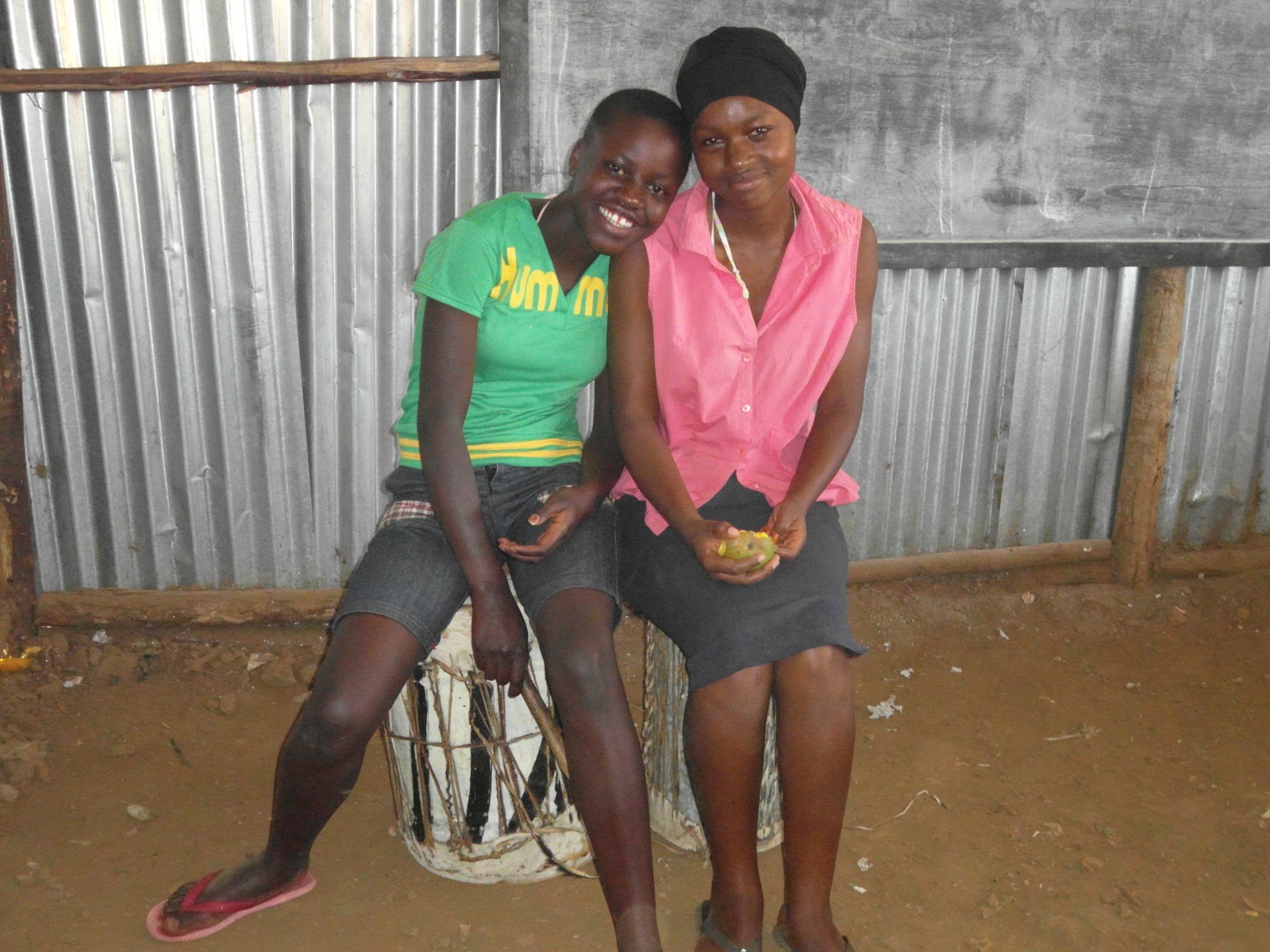
Lucy (foreground) and Mwendi (background)
I made up a members form to get the girls contact information, interests, abilities, skills, and limitations. I handed the forms out at our meeting, and sure enough, there were 5 young women (all young mothers) eager and willing to do SOMETHING. At that first meeting, it was revealed that the women were interested in forming a self-help group. A self-help group is a formally registered group in Kenya whereby its members work together to help one another out. We are now working on registering the group, we are short 3 members for registration (total members is now 7). We have already written our Constitution and have established regular meetings and weekly dues. Once we find three more members who are serious and willing to join the group, we will start the bureacratic process of meeting Kibera's Chief and ministry offices. We have also come up with a number of income generating ideas. The women have been diligent in doing their business research and we have struck many businesses off the list that are not looking profitable. Currently we are looking into three ideas: making charcoal briquettes, opening a cereal shop, making and selling soap. In fact, this morning, I am heading out to Karioko market to see how feasible it will be to make charcoal briquettes.
At Lucy's house in Kibera (our meeting place is a little cramped)
Though I have spent considerable time with my two community organizations (Kush-Ites and Kibera Ladies), I am still very much a member of Shiriki organization. In fact, I have some very exciting news to report. I previously mentioned that we had entered a blog competition about Youth in Agriculture. I found the blog competition online, and thought it would be an interesting way to record our progress, train staff on blog creation all the while sharing our ideas and methods with the world. The competition has now closed and though we didn't win, we were the runners up in East Africa!!! This means that they are going to pay for one of our members to travel down to South Africa to network about agriculture, meet other youth with similar mandates, and receive the runners up prize. Praises to the Most High... I am so excited about this outcome. It is always nice to see projects come to fruition. I am off to the Maragua farm this Easter weekend to see the progress that has been made there.
The water is running over at Soweto Academy. The water pump has now been fixed, and I have been helping Elsie market the water to different shops, stores and Health clubs in Nairobi. I have not spent too much time in marketing before, so this was new territory for me. However, I found it enjoyable to talk about Soweto Academy, and how the water profits go back into the Kibera community. I have signed up many new shops from my Dagoretti community with the HELP of several KUSH-ITES members who have taken me around, exhausting their connections in the Dago community.
Mama making mandazis Dago
For those of you who follow my updates, I know it must sound like I am involved with many different things. I have used this year as a time to scope things out, learn about the language, culture, lifestyle and challenges of living in Kenya. I have more that I wish to update, but this morning, I must get going. Wishing everyone many many blessings.
Sitting in a matatu at 8 o clock at night, waiting in traffic to get home, I get a text. I read: "usi sahau kuhusu kesho asabuhi" Translation: don't forget about tomorrow morning! Right, I promised one of my neighborhood youth, Shuba, that we would go hiking up Mt. Longonot tomorrow morning. Though in the moment I felt tired and my first reaction was to look for an excuse of why I couldn't go, upon failing to come up with one, I awoke early the next morning and had a fantastic day.
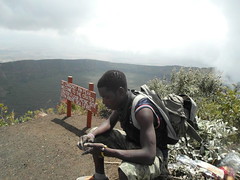
Shuba at the summit
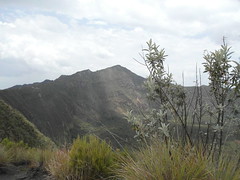
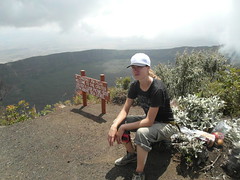
Mt Longonot is a dormant volcano located in the Rift Valley. You can take public transportation from Nairobi to the village of Longonot, and then walk to the base of the Longonot National Park. It takes about one hour to reach the rim of the volcano (a very steep and gruelling hour). Add another hour to make it to the highest point of the volcanic ridge. Though we collapsed at the top, it was victory all the way. We continued along the 2 mile volcanic rim surrounded by butterflies. It was surprisingly cool, and though my muscles ached the next day, it was a much needed day away from the city.
Butterflies were everywhere
Me at the summit
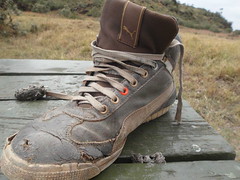
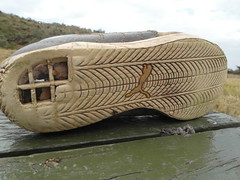
My shoes have travelled the world with me, and though I know they are almost done, I can't bear to throw them away. I couldn't help but take a picture of the wear and tear. Sadly, they will not make the trip back to Canada.
Kenya has an abundance of beautiful women from the young children dancing in the streets, to the older mamas selling vegetables along every residential street. The vegetables taste so sweet, much more flavour than the ones back in Canada (sorry, but true). This is my favourite mama to buy vegetables from. My favourite meals to cook involve buying greens such as pumpkin leaves or sakumawiki (kale), etc... and cooking them up with tomatoes, carrots, garlic, ginger and any other locally available vegetables. Mix the following together, possibly add some beans or soy for protein, and walaa: the most delicious vegetable creations you can imagine.
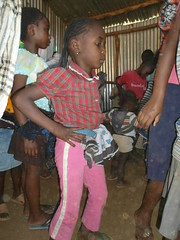
There is a local dance class that I attend. Though the class targets children, anyone can attend and get involved in the enthusiasm that is African dance. This class takes place in Kibera and was organized by a phenomenol young woman named Anna. She is an 18 year old young mother of two raising her children alone (not uncommon in Nairobi). She is skilled with the drum, with dance and with song. Here is a video of the class that I shot last Saturday. Their vision involves buying uniforms and marketing themselves to perfrom at local events and shows. What they lack in resources, they make up for in enthusiasm, joy and talent!
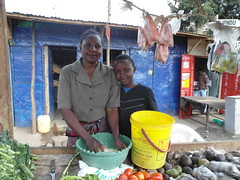
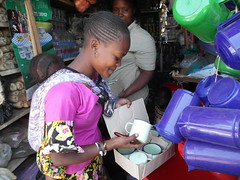
I continue to work with the youth and am helping them start their own businesses. This last week I had the opportunity of spending considerable time with Costanzia, my beautiful young friend from Tanzania. Again, Costanzia is a young mother with a 2 year old daughter. She is raising her daughter by herself and ever since I have known her, has been engaged in work involving long hours (10 hours a day), hard work (cleaning, cooking, washing) and very low pay (ranging from 75 cents to $1.50 per day). After speaking with Costanzia at length, it was revealed that she would like to open up a cafe of her own. She has worked for other women at kiosks for years, and has the skills, abilities, customer relations and know how to start up her own business. This week we decided it was time to get this started. Costanzia found a kibanda to rent, we made a list, a budget, and bought all the necessary supplies.
Buying supplies for her restaurant
Costanzia's kibanda
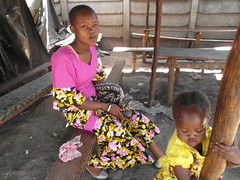
There is another young women I have become involved with. Her name is Francisca. Another single mother raising a 5 year old son on her own, and pregant with her second child. She has had many complications with this pregnancy, and fortunately, I have been able to help her with some of the necessary procedures. She is a skilled salonist, and though she is unable to work at the moment due to her troubled pregnancy, she is planning on getting back to work as soon as her baby has been born. She lives in the Kawangware slums.
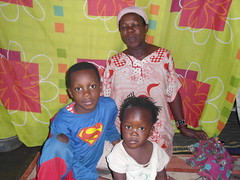
Fransisca with her son and nephew
I have now shared a small glimpse into the lives three young women. All mothers, all raising their children on their own. This begs the question of why? The young women that I know are intelligent, focused, hard-working and constantly planning for the future for themselves and their children. Yet, why is there this overwhelming pattern of young pregnancies, father abandonment, and single mothers living in poverty? The emergence of single mothers has become a social norm in Nairobi. One reason involves the under-use of contraceptives and the pressure placed on young women to prove their love to their boyfriends. Despite Kenya's extremely conservative outlook on pre-marital sex, the irony is that young pregnancies are prevalent everywhere. Further, while abortion is illegal in Kenya, this doesn't mean it doesn't happen. Instead, women undertake this dangerous procedure themselves removing their pregnancies and abandoning the fetus in one of Nairobi's garbage dump sites. The result of increased urbanization, and the subsequent weakening of traditions and customs combined with poverty has resulted in this occurrence.
Johnstone, the principle of Soweto Academy once said to me "There is one thing that African men are very good at: getting women pregnant and dissapearing." In addition, the young women always seem to speak about their children's estranged fathers as their husbands. Apparently there is this idea that they are "married". Though no documentation exists, nor is the father present, there is an overhwleming desire to be married, especially among the urban poor. I assume some discussion took place that the couple is married, the pregancy commences, the child is born, the man dissapears (presumably acquiring another "wife" elsewhere).
Nonetheless, the women remain responsible, positive and incredibly hard working to provide for their families. In fact, there are numerous microfinance organizations that primarily target women and women's groups. I have had several lengthy discussions with one microfinance organizations in particular called TUDEP (Tujikuze Development Program). This group provides loans to women who are part of a women's group. The loans are incredibly low interest, and works on a system of group accountability. In addition, they only provide loans to women. I talked with a credit officer who told me that the men, in general, are much less likely to pay back the loan then women. Interesting ... Microfinance is big business in Kenya, though one challenge remains. As small microfinance institutions grow, they are struggling to find the capital necessary for company expansion.
Soweto Academy continues to push onwards and upwards. I am anxiously awaiting response from the Safaricom Foundation to hear whether or not the computer project will be funded. I was told three weeks ago that I would receive a response. How wonderful would it be to begin teaching ICT to these young women. I would love to be able to volunteer my skills and expertise in the computer classes as well. Alas, it is in God's hands. As for the water bottling company, the focus has changed from obtaining external funding to marketing the water. Great, I spend too much time at my computer already, let's get out there and sell some water! I have offered my assistance for this endeavor and have added two new clients to Soweto's roster. Hopefully by my next post we will have added many more.
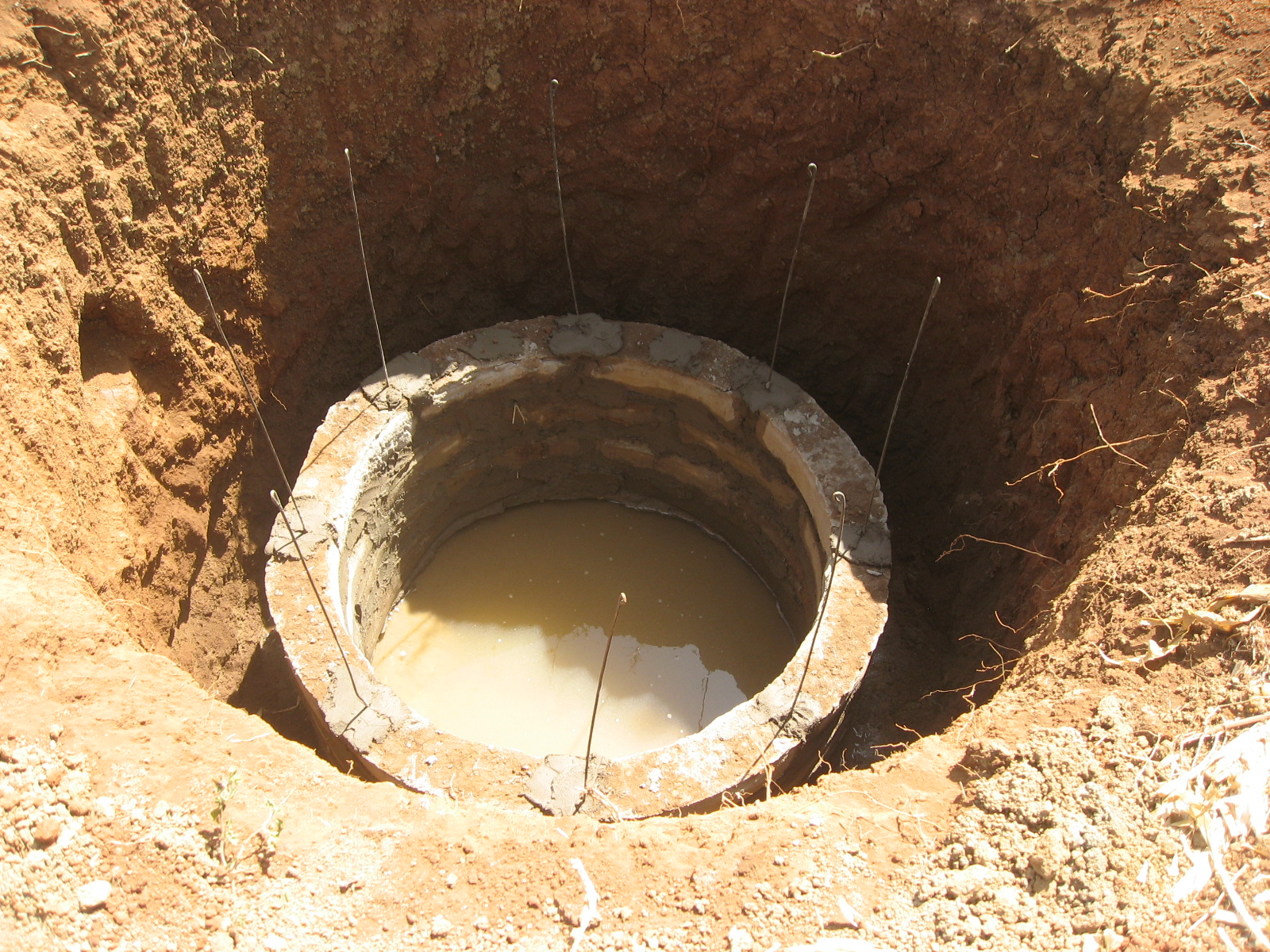
Shiriki organization is also doing great. Through hard work, know-how, and community help, they have begun the construction of a well on-site. In addition, the harvest continues in Maragua and fresh maize, cowpeas, beans and soya have been ripe for the picking. There is nothing as good as nourishing on your home-grown fruits, vegetables and grains. In addition, we have been sending out a funding proposal to obtain machinery, materials and a workshop for the shoe industry. While resources continues to be a challenge, and the shutting down of the music studio was hard felt, everyone continues working together to uplift the urban and rural communities.
While I commonly write about my experiences from a very positive standpoint, there are harsh realities that Kenya's communities face on a daily basis that I struggle with. Substance abuse is an enormous problem among Nairobi's youth. One of my favourite Dagoretti youth is a regular drug addict. He used to be a Dj and constantly talks in Dj mode "Sista Joelle, mzuri SANA, Blessed Love, Blessed Love, Mzuri SANA". My first impression of him was judgemental and somewhat annoyed. Yet, I have seen this young man perform incredible acts of kindness that made me think of the good samaritan. Another youth-man was badly beaten up and left on the side of the road a couple weeks back. While everyone simply walked over, around or beside him, this guy picked him up, brought him to shelter, nursed his wounds, and brought him food and water.
I have heard stories about friends shot down by police or local gangs, yet I have only seen a glimpse of this brutality. I listen to their stories, but have no idea what life must be like for them. I can see how real the trauma is, and how difficult it is to talk about. During the post-election violence of 2007, these youth have witnessed and experienced atrocities. Here is a story I was told:
During the post-election violence I never went out at at night, and had to be extremely careful during the day. It would be better to stay underground all the time, but we needed to find food, so didn't have a choice but to emerge and hustle on the streets. I was walking with my friend when members of the Mungiki called out to us. "What's your name?" "Who are you?" I knew they would recognize our tribe from our names, so I took off running. My friend froze in his tracks, and when I looked back to locate him, I saw him kneeling down in front of them. Using machetes they cut off both his hands. I stood in horror and couldn't watch them finish him off. I froze in shock until I realized they were now running after me. Sprinting hard through the streets of the slums I blindly ran into a dead end. I was cornered against tin shack buildings and the river of sewage 20 feet below. With no where else to turn, I jumped, straight into the sewage. Thanks be to Jah my life was spared that day, though I had to immerse myself in the rivers of human waste, none of the Mungiki jumped after me and I managed to get home to see another day.
I walk through the slums each day, and tolerate the sewage trenches, human waste, sick children, and young prositutes. I see the young mothers struggling to feed their families and turning to prostitution as a means of survival. I empathize, but at the end of the day, I get to go home to my safe, clean, secure apartment. I have a warm bed, food, and a comparitively large bank account. They don't have these luxuries. While I believe I have bridged some sort of a divide by forging meaningful relationships with individuals and organizations from a very different walk of life than mine, I know that we are not the same. Their challenges are not my challenges, their trials are far harsher than my trials, and when they fall, they often fall hard with no one to pick them up. As horrible as it sounds, I can see survival of the fittest taking place before my eyes. Truly, these young men and women are warriors, yet I have seen some of the brightest lights emerge through their lives. It reminds me of a quote I was told yesterday by another street warrior: In every person's soul is the image of God waiting to be seen.